“Kaisi yeh paheli mua dil marjaana! Ishq mein jaldi bada jurmana (What is this dilemma, oh stubborn heart! It will incur us too heavy a fine to be hasty in love)”
Like all great love stories, ours too began with the love of Shah Rukh Khan.
Anushree was burning with fever in Delhi, and I was unraveling in Visakhapatnam under the weight of anxiety attacks, when, like would happen in Bollywood, hawaaon ka rukh badalne laga (the winds began to change direction). All through September of 2023, we had been moonlighting across each other’s Twitter timelines during the #2000sBollywoodBracket – not as lovers but as rivals, locked in the throes of a tournament of 512 songs fighting for the crown of the decade’s most beloved. Think madness, mayhem, noble judges on Twitter deciding the fate of songs that had once ruled our childhood bedrooms and wedding sangeets. Think madness, think mayhem, think noble judges on Twitter deciding the fate of songs that had once ruled our childhood bedrooms and wedding sangeets.
Come October 2nd, the bracket had ended Our hangover had not.
It was then, through what Anushree now swears was a carefully laid trap that I learned they had never seen Veer-Zaara. What choice did I have but to assume my celestial duty? Before that day, we had only been mutuals on Twitter, riffing with memes and banter over which songs deserved glory. But suddenly, this was about more than a Veer Zaara song not having won the bracket (about which I was admittedly still bitter). This was about the delicious opportunity to be the one to bring a film as tender and luminous as Veer Zaara into someone’s life. I would only realise later, that maybe Veer Zaara wasn’t the opportunity at all, only an opening. Maybe the opportunity all along was that it would bring someone as tender and luminous as Anushree into my life.
What should have been a three-hour film stretched into five and a half no thanks to my frequent interrupting to gush with a factoid about this scene and trivia about that song for Anushree but somehow my endless yapping didn’t send them running the other way.
True to sapphic gospel, the following week, dissolved into a blur of ‘friendly’ flirting, exchanging texts from the moment our eyes awoke till sleep dragged us under, entire conversations in Bollywood song lyrics, meme matches and song dispatches, musings about gender euphoria, dysphoria, conflict resolution, childhood injuries… movies, music, astrology, disability, more movies together. In those early days, we didn’t notice how much ground we were covering, only that it felt endless, urgent and inevitable.
Seven days in, we decided this was a relationship and only a fortnight later did we realise we hadn’t even video called each other yet! Today, two years into loving this most lovely trans non-binary autistic queer person, I can map our love through moments where I pause to ask myself, “what is it about us that isn’t like anyone else?” The answers come in ripples.
If you were to meet us, Anushree and I are like chalk and cheese—or perhaps cheese and chalk. They love to experiment with food, while I remain painfully indifferent (perhaps disability does that to one). In a social setting, Anushree is reserved, measured, speaking sparingly; while I am the fast-thinking loudmouth, words tumbling over each other in a desperate race to keep pace with my thoughts. Where they take their time, I make haste—because that’s the only way my ADHD brain believes anything will get done.
But for all these petty divergences, what draws me most to Anushree is how fiercely they want to stay politically alive to the world, as I do. We may have our annual ritualistic rewatch of Veer-Zaara, or sit through another nail-biter of a Day 5 Test match (indeed, we love Test cricket). Just as often, though, our nighttime viewing is a press conference on election scams. Debates that follow—stretching into breakfast—are as passionate about bowling combinations as they are about distraction ploys of the government. Between a communist reading circle here and a theatre piece on caste and food there, what is never spoken between us is that tired refrain: “you’ll only overwhelm yourself if you think of all these politics; we can’t change the world.”
Anushree and I are careful not to become each other’s world. We protect each other’s worlds instead. The soul juice, as I like to call it, which makes up Anushree changes with the seasons of their autistic special interests: astrology and tarot, an immersion in books, a new mobile game every few weeks. They, in turn, guard mine—painting and craft, singing, wandering in nature, discovering world cinema. Gratitude and joy abound in the sharing: reading together, painting side by side, laying out a tarot spread, watching a Brazilian film late into the night. Yet the story of us is not all montage and music—our love takes shape as much in these tender harmonies as in the resistances, protections, and survivals that make it real.
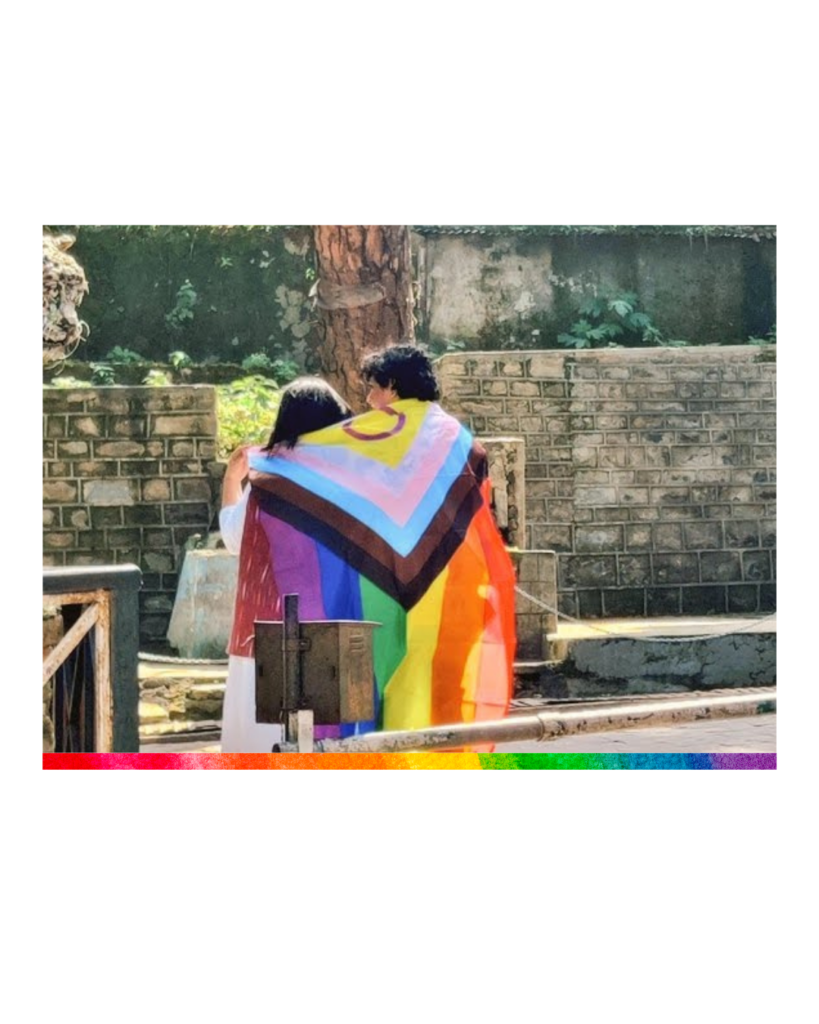
Our life is stranger, messier, truer than filmy perfection. When we decided to move in together, neither of us cut our hair short to sell the image of ‘cisgender friends looking for a flat,’ wary that our queerer haircuts might give our trans-ness away. The queerness of our household lives in curtains drawn tightly against a middle-class, upper-caste, cis-heterosexual neighbourhood that would rather not imagine a family like ours. And yet, it spills out in the ways we resist: in persisting with they/them pronouns even when the doctor frowns in confusion, ‘when you say “their symptoms” I feel like is there someone else also?”; in the inclusive pride flag draped across our shoulders at a military monument; in Anushree strutting in masc shirts, unbothered by the stares; in my rainbow coloured eyeliners, in surprise kisses and proudly held hands – in the discomfort we refuse to inherit from onlookers.
But after all that protest, when we step back inside, behind those drawn curtains, the texture shifts. Comfort and softness take priority. There is only as little furniture as we absolutely need, the house echoing instead with the forty-second pet name for me that Anushree has coined that morning, or the two I’ve used for them since the beginning. As two neurodivergent people, making space for our wild minds is a daily negotiation: Anushree tidying a little extra so my anxiety doesn’t spiral, me slowing down with chores so their demand avoidance doesn’t bite. We fumble, adjust, try again.
And then there are the messier truths. A disabled household is a household of sick days—sometimes mine, sometimes theirs, sometimes both of us together, bed-bound and drained of the energy to even order food. I live with ME/CFS, and when a crash flattens me for a week, or when Anushree falls into autistic shutdown, the house falls silent and days blur. Being a disabled household also means chores aren’t split in half, or by day, or by any system at all—we never know who will be able to get out of bed, or for how long. Some days I cook and clean like a ninja; other weeks, Anushree shoulders it all on top of their job. Caregiving isn’t romantic—it is hard, slow, back-breaking work. It takes boundaries, self-awareness, and more communication than most people put into four relationships combined.
But if abled life couldn’t be an option, I would not choose any other way to be disabled than this: falling asleep to the rattle of medication, Anushree’s sleepy hands warm against my belly, waking to the tangle of their legs with mine, kissing their forehead before we both surrender to sleep—hoping for a few more spoons with the morning light. Because through it all, we’ve found ways to laugh: at my disability, at our madness, at the larger systems that are the real root of our suffering. We’ve built a language that belongs only to us, where crises shrink to the size of a few conversations, or dissolve altogether in the lilt of a Bollywood song or the rhythm of a cricket commentary.
Ours is no tidy victory—but something rarer: a love that plays the long game, that insists on showing up, scene after scene, day after day. What began with a song bracket and a Teleparty has become a household, a language, a long game of care. In a world that refuses to script us, we keep writing anyway—our own trans-nonbinary Veer-Zaara, our own commentary, our own unruly tongue.
“Tracing Trans Joy in Love and Everyday Life”
Kaisi yeh paheli mua dil marjaana! Ishq mein jaldi bada jurmana.
(What is this dilemma, oh stubborn heart! To be hasty in love will incur too heavy a fine.)
All love stories need a beginning. Ours began with Shah Rukh Khan, a Twitter bracket, and a stubborn refusal to let Bollywood be the only thing dramatic about our lives. What followed was not just romance, but the slow, deliberate making of a queer, disabled household that insists on joy.
In September 2023, Anushree was burning with fever in Delhi while I was unraveling in Visakhapatnam under the weight of anxiety attacks. And yet, as in Bollywood, the winds began to shift. We met not in person but across Twitter timelines, rivals in the #2000sBollywoodBracket. Five hundred and twelve songs went to war for the decade’s crown; noble judges of Twitter decided the fate of anthems that once ruled our childhood bedrooms and wedding sangeets.
Come October 2nd, the bracket had ended. The hangover had not.
Through what Anushree swears was a carefully laid trap, I learned they had never seen Veer-Zaara. What choice did I have but to step into destiny and introduce them to the epic? Until then, we had only been Twitter mutuals trading memes and banter. But suddenly, this was bigger than a film bracket. Maybe Veer-Zaara wasn’t the real opportunity at all — maybe Anushree was.
What should have been a three-hour film stretched into five and a half, thanks to my endless trivia and interruptions. But somehow, my yapping didn’t send them running the other way.
From Rivals to Lovers
True to sapphic gospel, the following week blurred into friendly flirting, Bollywood lyric battles, meme exchanges, musings on gender euphoria, dysphoria, and childhood scars. We texted from the moment our eyes opened till sleep dragged us under.
Seven days in, we decided this was a relationship. Only a fortnight later did we realize we hadn’t even video called each other yet. Two years later, loving this tender, luminous trans non-binary autistic queer person, I often pause to ask: what is it about us that isn’t like anyone else? The answers come in ripples.
We are chalk and cheese, or perhaps cheese and chalk. Anushree experiments with food; I remain indifferent, perhaps numbed by disability. They are reserved in social settings; I am the fast-talking loudmouth. Where they take their time, my ADHD brain insists on haste.
And yet, what binds us is fierceness — the need to stay politically alive to the world. Our nights alternate between watching a Bollywood classic and watching press conferences on election scams. Our debates stretch into breakfast, as passionate about the previous day’s test match as about government distraction ploys. Between communist reading circles and theatre pieces on caste and food, what we never say to each other is the tired refrain: “don’t overwhelm yourself with politics, you can’t change the world.”
Guarding Each Other’s Worlds
Anushree and I are careful not to become each other’s whole world. We protect each other’s instead. Their soul juice changes with seasons of autistic special interests — astrology, tarot, books, or a new mobile game. They guard mine — painting, singing, wandering in nature, world cinema. Gratitude abounds in the sharing: reading together, painting side by side, laying out a tarot spread, watching a Brazilian film late into the night.
Our love is not only montage and music, but also resistances and survivals. When we decided to move in, neither of us cut our hair short to sell the image of “cisgender friends” to landlords. Our queerness hides in curtains drawn tightly against a middle-class, cis-heterosexual neighborhood — yet spills out in the ways we resist: insisting on they/them pronouns at a doctor’s office, draping the inclusive pride flag across our shoulders at a military monument, Anushree strutting in masc shirts, me in rainbow eyeliners, kisses and handholding unbothered by the uncomfortable onlooker.
A Disabled Household
Behind those drawn curtains, comfort takes priority. Pet names multiply (Anushree invents a new one almost daily), chores bend around neurodivergence: they tidy extra so my anxiety doesn’t spiral, I slow down so their demand avoidance doesn’t bite. We fumble, adjust, try again.
And then there are the sick days. I live with ME/CFS; when a crash flattens me, or when Anushree falls into autistic shutdown, the house falls silent. Chores aren’t split evenly — we never know who will be able to get out of bed. Some weeks I cook and clean like a ninja; others, Anushree shoulders it all. Caregiving isn’t romantic. It is hard, slow, and demanding. But it is also love, stretched across time, patched with patience and laughter.
If abled life isn’t an option, then I would choose this disabled one: falling asleep to the rattle of medication, Anushree’s sleepy hand warm against my belly, waking to tangled legs and forehead kisses. Through it all, we’ve found ways to laugh: at my illness, at our madness, at the larger systems that are the real roots of suffering.
Joy as Resistance
Our love is no tidy victory. It is something rarer: a long game that insists on showing up, scene after scene, day after day. What began with a song bracket and a Teleparty has become a household, a language, a resistance stitched from Bollywood lyrics, cricket commentary, and quiet acts of care.In a world that refuses to script us, we keep writing anyway — our own trans disabled Veer-Zaara, unruly, and stubbornly joyful.